Avascular necrosis of the femoral head — also called osteonecrosis, or AVN — is one of the few orthopedic conditions where "we caught it early" genuinely changes the outcome. The blood supply to the ball of the hip joint is interrupted, a segment of bone dies, and if nothing intervenes that dead segment loses its structural strength and collapses. Once the femoral head collapses, the joint surface deforms, arthritis follows quickly, and a hip replacement becomes close to inevitable.
That timeline is why AVN attracts real interest in regenerative medicine — and why it attracts so much overclaiming. Cell-based therapy here has a genuinely respectable evidence base, including randomized trials with ten-year follow-up. It is also sharply stage-dependent, at least one well-run randomized trial found no benefit at all, and late-stage patients are frequently sold treatments that cannot help them. This post walks through what the literature actually shows, including the parts that don't flatter the therapy.
Quick answer
- Pre-collapse AVN (ARCO/Ficat stages I–II): Where the evidence is strongest. Multiple controlled trials report that adding bone-marrow-derived cells to core decompression reduces progression and delays or avoids hip replacement versus decompression alone. It is not a cure, and a meaningful minority still progress.
- Post-collapse AVN (stages III–IV): Outcomes drop sharply. In the largest long-term series, most post-collapse hips still needed a replacement. We generally don't recommend cell therapy to avoid surgery at this stage.
- The evidence is real but mixed. A 2023 meta-analysis of 18 studies favored adding cells; a 2016 randomized trial found no difference. Anyone quoting only one side is selling something.
- Delivery matters. The published benefit comes from cells placed into the necrotic lesion, usually alongside core decompression — not from a joint injection or an IV drip.
- Cost in Medellín: roughly $4,500 to $6,000 per hip, depending on protocol.
What AVN is — and why it isn't arthritis
People often arrive having been told they have "hip arthritis," and the distinction matters. Osteoarthritis is a wear problem: cartilage thins over years, usually in older patients, and the bone underneath is alive. AVN is a blood supply problem: a segment of bone in the femoral head dies while the cartilage above it is often still intact, and it disproportionately affects people in their 30s, 40s and 50s.
The common causes are well established — long-term or high-dose corticosteroid use, heavy alcohol intake, hip trauma, sickle cell disease, and a substantial idiopathic group where no cause is ever found. If you've taken significant steroids and developed hip or groin pain in your 40s, AVN belongs on the list and an MRI is the way to answer it.
The practical consequence: in early AVN you're not trying to regrow a worn-out cartilage surface. You're trying to revascularize and repair a segment of dead bone before the roof caves in — while the cartilage above it is still healthy. That's a more tractable biological target, and it explains why the AVN cell-therapy literature is stronger than the hip osteoarthritis literature. If arthritis rather than necrosis is your actual diagnosis, our honest look at stem cell therapy for hip osteoarthritis is the more relevant read.
Staging: the single most important variable
Nothing predicts your outcome more than whether the femoral head has collapsed. AVN is staged with the ARCO (Association Research Circulation Osseous) system or the older Ficat classification. The line that matters is stage II versus stage III — the moment of subchondral fracture and collapse.
| Stage | What the imaging shows | Cell therapy fit |
|---|---|---|
| ARCO I | X-ray normal; MRI shows the necrotic lesion. No collapse. | Best-evidence candidate |
| ARCO II | X-ray changes (sclerosis, cysts); femoral head still round. No collapse. | Reasonable candidate; lesion size matters |
| ARCO III | Subchondral fracture / "crescent sign"; the head has begun to flatten. | Poor — outcomes drop sharply; usually surgical |
| ARCO IV | Joint space narrowing, secondary arthritis, deformed head. | Not appropriate — hip replacement is the answer |
Lesion size and location matter too. A small medial lesion behaves very differently from a large one sitting under the main weight-bearing zone, even at the same stage. That's why we ask for the actual MRI images, not just the radiology report.
What the procedure actually involves
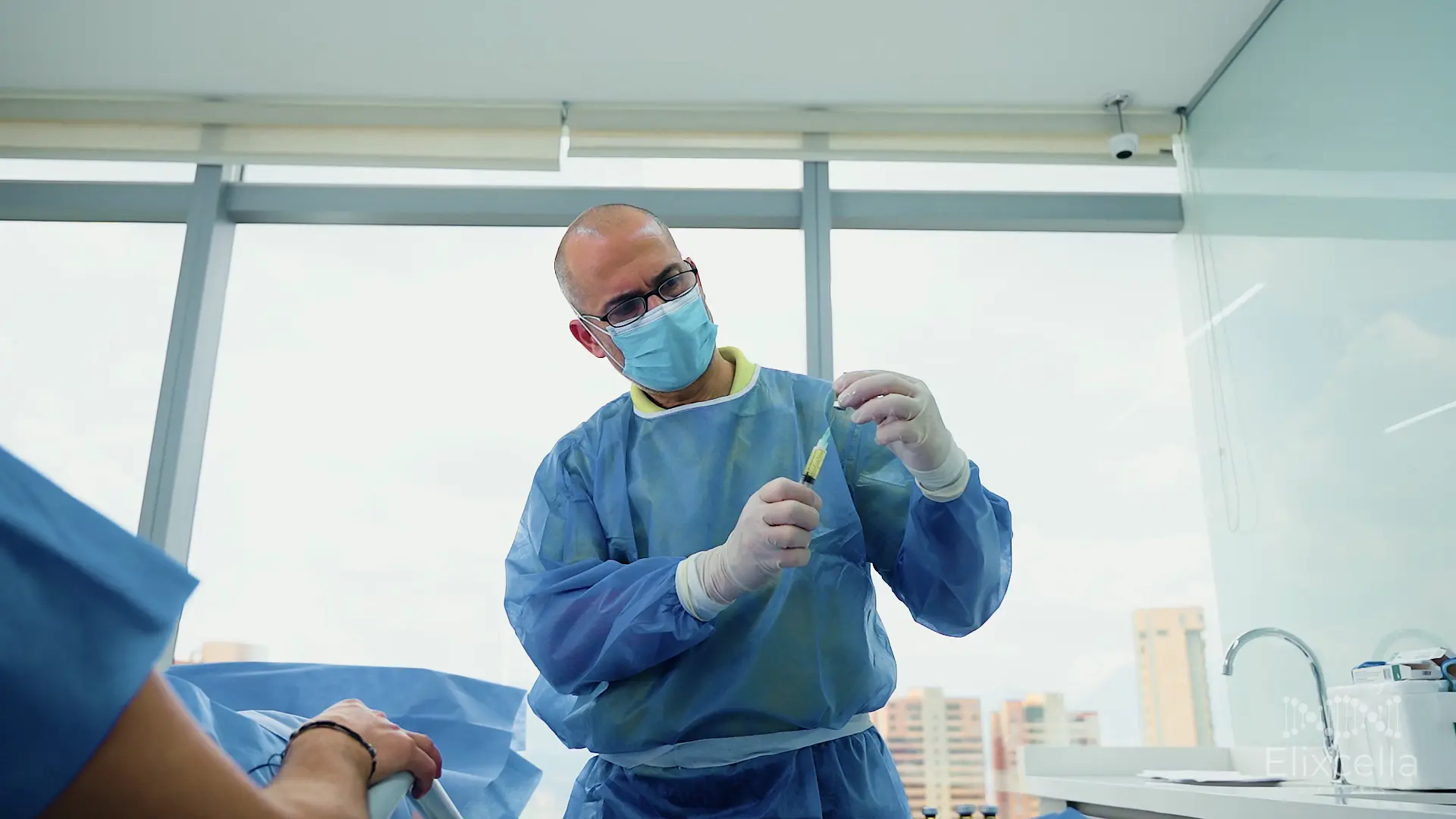
An important clarification, because this is where a lot of marketing goes wrong: the published evidence for AVN is built on cells delivered into the necrotic bone lesion, almost always combined with core decompression — not on intra-articular joint injections, and certainly not on intravenous infusions.
Core decompression itself is a long-standing orthopedic procedure: a channel is drilled into the femoral head to relieve intraosseous pressure and stimulate healing. It has modest benefit on its own. The regenerative addition is to concentrate bone marrow — typically aspirated from the patient's own iliac crest — and instill that cell-rich concentrate into the decompressed lesion, on the rationale that the necrotic segment is depleted of the osteoprogenitor cells needed to rebuild bone. That rationale has direct support: Hernigou's group found patients who received more transplanted progenitor cells had better outcomes — a dose-response relationship, which is what makes a mechanism credible rather than coincidental.
What the published evidence actually shows
Here is the honest read, including the trial that didn't work.
- Hernigou & Beaujean (2002, Clinical Orthopaedics and Related Research) — the foundational series: 189 hips in 116 patients treated with core decompression plus autologous bone marrow grafting, followed 5 to 10 years. Of 145 hips treated before collapse (stages I–II), only 9 needed a hip replacement. Of 44 treated after collapse (stages III–IV), 25 needed one. That contrast is the most important number in the field.
- Gangji et al. (2011, Bone) — a five-year, blinded, controlled study in early-stage AVN. At 60 months, 8 of 11 hips in the core-decompression-only group had progressed to the fracture stage, versus 3 of 13 in the bone marrow group. Small numbers, but a real control group and a clear separation.
- Zhao et al. (2012, Bone) — 100 patients with early-stage AVN randomized to cultured bone-marrow MSC implantation or core decompression. At 60 months, 2 of 53 treated hips had progressed, versus 10 of 44 in the decompression group.
- Li et al. (2020, Stem Cell Research & Therapy) — a prospective, double-blinded, randomized trial reporting ten-year follow-up. Mean hip survival was 102.3 months with core decompression plus bone marrow buffy coat versus 78.1 months for decompression alone. Notably, preoperative Ficat stage III was an independent risk factor for failure — the stage effect again.
- Pepke et al. (2016, Orthopedic Reviews) — the negative trial, and it deserves equal billing. A randomized prospective study of 24 patients found no difference in clinical outcome or head survival between core decompression with and without bone marrow concentrate at two years. Any clinic that cites the positive trials and hides this one is not being straight with you.
- Saini et al. (2023, The Surgeon) — a systematic review and meta-analysis of 18 studies. Pooled, adding bone-marrow-derived cell therapy to core decompression was associated with lower disease progression (odds ratio 0.19) and lower conversion to hip replacement (odds ratio 0.20) versus decompression alone. The review also found increasing age and post-collapse stage adversely affected outcomes.
Read together: the balance of evidence favors adding cells to core decompression in pre-collapse AVN, the pooled effect sizes are substantial, and the safety record is reassuring — but the trials are mostly small, one well-conducted randomized trial found nothing, and none of this amounts to a guarantee for any individual patient.
The most useful number in the AVN literature isn't an effect size — it's the stage split. Treated before collapse, most hips in Hernigou's series never needed a replacement. Treated after collapse, most did. Timing is doing more work here than any protocol detail.
Timeline: what to expect
Responses vary, and some patients don't respond. For those who do, the curve is slower than people expect — you're waiting on bone remodeling, not an anti-inflammatory effect.
Weeks 1 to 6: Protected weight-bearing on crutches while the decompression channel heals. Some soreness at both the hip and the iliac crest harvest site.
Months 2 to 4: Gradual return to full weight-bearing. Pain relief often begins here, though it can be uneven.
Months 6 to 12: When MRI can start to show whether the necrotic lesion is stabilizing or shrinking — the honest checkpoint for whether it's working.
Years 1 to 10: What actually matters is whether the femoral head stays round. The long-term trials measure success in years of hip survival, not weeks of pain relief — and so should you. Anyone promising a fast, dramatic result for AVN is describing something other than bone healing.
Cost: Medellín vs. US
| Treatment | Colombia Care, Medellín | US (where available) |
|---|---|---|
| Core decompression with cell concentrate, single hip | $4,500 to $6,000 | $20,000 to $40,000 |
| Hyperbaric oxygen adjunct (10 sessions) | Often bundled (~$1,200 value) | $3,000 to $5,000 separately |
| Total hip replacement (alternative) | Not offered (we don't do surgery) | $30,000 to $60,000+ |
Trip costs add roughly $1,200 to $2,000. Most US carriers don't cover cell-based procedures regardless of location, though HSA/FSA funds typically can be used, and we provide an itemized English invoice for out-of-network claims. Our breakdown of why stem cell therapy costs 60–75% less in Medellín explains where the difference comes from.
Who is — and isn't — a candidate
You're more likely to be a reasonable candidate if:
- Your MRI shows ARCO stage I or II — a necrotic lesion with no subchondral collapse.
- Your lesion is small to medium and not dominating the main weight-bearing zone.
- You're younger — the meta-analysis data show outcomes worsen with increasing age.
- The underlying cause is addressed or removed — steroids tapered where medically possible, alcohol intake stopped. Treating the hip while the cause continues is treating a symptom.
- You can commit to protected weight-bearing and follow-up imaging.
This may not be right for you if any of the following apply:
- The femoral head has already collapsed (ARCO III–IV). The evidence does not support cell therapy as a way to avoid a replacement once the joint surface has fractured or flattened.
- Secondary arthritis is established and the joint space is narrowed.
- The lesion is very large and occupies most of the weight-bearing surface — mechanics work against biology here.
- Ongoing high-dose steroid therapy that cannot be reduced, or continued heavy alcohol use.
- Active infection, or a bone marrow disorder that compromises the graft source.
- You want a single IV infusion instead. There is no meaningful evidence that intravenous stem cells treat AVN of the femoral head. That's a different protocol for different indications — see our overview of IV stem cell therapy for what it is and isn't for.
The honest part: late-stage AVN usually still needs a hip replacement
We want to be unambiguous, because AVN patients are among the most aggressively marketed-to people in regenerative medicine. Once the femoral head has collapsed, the problem is mechanical, not biological. No injected cell population rebuilds a fractured, flattened weight-bearing surface into a round one. Hernigou's own long-term data make the point: 25 of 44 post-collapse hips went on to replacement despite bone marrow grafting.
Total hip replacement is one of the most reliable operations in medicine. For a collapsed femoral head causing daily pain, it is very often the right answer, not a failure. If your imaging shows stage III or IV disease, we'll tell you directly and recommend an arthroplasty surgeon. We'd rather lose the booking than take money for a procedure your imaging says won't work.
Imaging you'll need before booking
- MRI of both hips — non-negotiable for AVN. It's the only way to stage early disease, size the lesion, and check the asymptomatic other side (bilateral involvement is common).
- Weight-bearing AP pelvis and frog-leg lateral X-rays within the last 6 months — to assess collapse.
- Your medical history — specifically steroid exposure (dose and duration), alcohol history, trauma, sickle cell or clotting disorders.
- Prior orthopedic or rheumatology notes.
Our regenerative medicine physician reviews each case personally and replies within 48 hours with an honest assessment: your stage, whether the evidence supports treating you, realistic expectations, and a quote. Cases that aren't a good fit are told so plainly. If you're weighing the logistics of traveling, our complete US patient's guide to stem cell therapy in Medellín covers the trip end to end.
The bottom line
Avascular necrosis is, in our view, one of the more defensible indications in orthopedic cell therapy — not because results are guaranteed, but because a multi-decade, randomized-and-controlled evidence base points in a consistent direction for a clearly defined patient: pre-collapse, adequately staged, with the underlying cause addressed. The pooled data suggest meaningfully lower rates of progression and hip replacement when cells are added to core decompression. A well-run randomized trial still found no benefit, the studies are small, and results vary between individuals.
What isn't defensible is offering it to a collapsed hip. The window for this treatment is early, and it closes. If you've just been diagnosed and your femoral head is still round, this is worth an honest conversation — soon.