If your orthopedist has used the words "you'll probably need a knee replacement eventually," you have a decision to make. Total knee arthroplasty (TKA) works, but it's invasive, costs $35,000 to $70,000 in the US, replaces your native joint with hardware that wears out in 15 to 20 years, and rarely returns the joint to a pre-arthritic feel. The window between "this hurts" and "I need surgery" is exactly where stem cell therapy fits.
This post is for patients who are in that window. We cover what the imaging needs to show, which Kellgren-Lawrence grades respond best, what the published outcomes actually look like, the timeline, the realistic cost in Medellín, and the cases where we tell patients honestly that surgery is the better path.
Quick answer
For a typical knee osteoarthritis patient in 2026:
- KL grade I-II (mild to moderate): Stem cells are a strong fit. Outcomes are most consistent in this band, with most patients reporting meaningful pain reduction and functional gains.
- KL grade III (moderate to severe): Stem cells still help, particularly when combined with hyperbaric oxygen and structured rehab. Outcomes are more variable.
- KL grade IV (bone-on-bone): Stem cells are usually not the right call. The cartilage runway is gone; the joint has been fundamentally remodeled. We refer these cases to orthopedic surgeons for arthroplasty.
- Cost in Medellín: $3,800 to $4,600 per knee for the injection protocol, plus optional adjuncts (hyperbaric oxygen, IV systemic infusion).
- Cost in the US (where available): $18,000 to $35,000 for the comparable injection, $35,000 to $70,000 for the surgery it's trying to avoid.
What knee osteoarthritis actually is
Osteoarthritis is not the wear-and-tear story most people are told. The cartilage that lines your knee joint isn't simply "running out." It's living tissue that depends on a careful balance of mechanical load, blood-borne signaling factors, and chondrocyte (cartilage cell) turnover. When that balance tips, chondrocytes die faster than they're replaced, the cartilage matrix loses water and structure, and the joint loses its shock-absorbing surface.
The pain doesn't come from cartilage itself (cartilage has no nerve endings). It comes from the surrounding tissue: inflamed synovium, irritated subchondral bone, and stressed ligaments compensating for joint instability. This is why two patients with identical imaging can have wildly different pain levels — and why interventions that reduce inflammation, even without rebuilding cartilage, can produce dramatic symptom improvement.
How orthopedists grade your knee: the Kellgren-Lawrence scale
Every conversation about treatment options starts with the imaging grade. The Kellgren-Lawrence (KL) scale, developed in 1957 and still the global standard, classifies osteoarthritis I to IV based on X-ray findings:
| KL Grade | What the X-ray shows | Stem cell fit |
|---|---|---|
| Grade I | Possible joint-space narrowing, possible osteophytes | Excellent |
| Grade II | Definite osteophytes, possible joint-space narrowing | Excellent |
| Grade III | Multiple osteophytes, definite joint-space narrowing, some sclerosis, possible bone-end deformity | Good, with adjunct protocols |
| Grade IV | Large osteophytes, marked joint-space narrowing, severe sclerosis, definite bone-end deformity | Surgery typically preferred |
If you don't know your KL grade, ask your orthopedist. It's the single most important piece of information for predicting whether stem cell therapy is the right call for your case. We also strongly prefer to see an MRI — X-rays show bone, but MRIs show the cartilage, meniscus, and synovium that tell us what we're actually treating.
How mesenchymal stem cells target knee cartilage
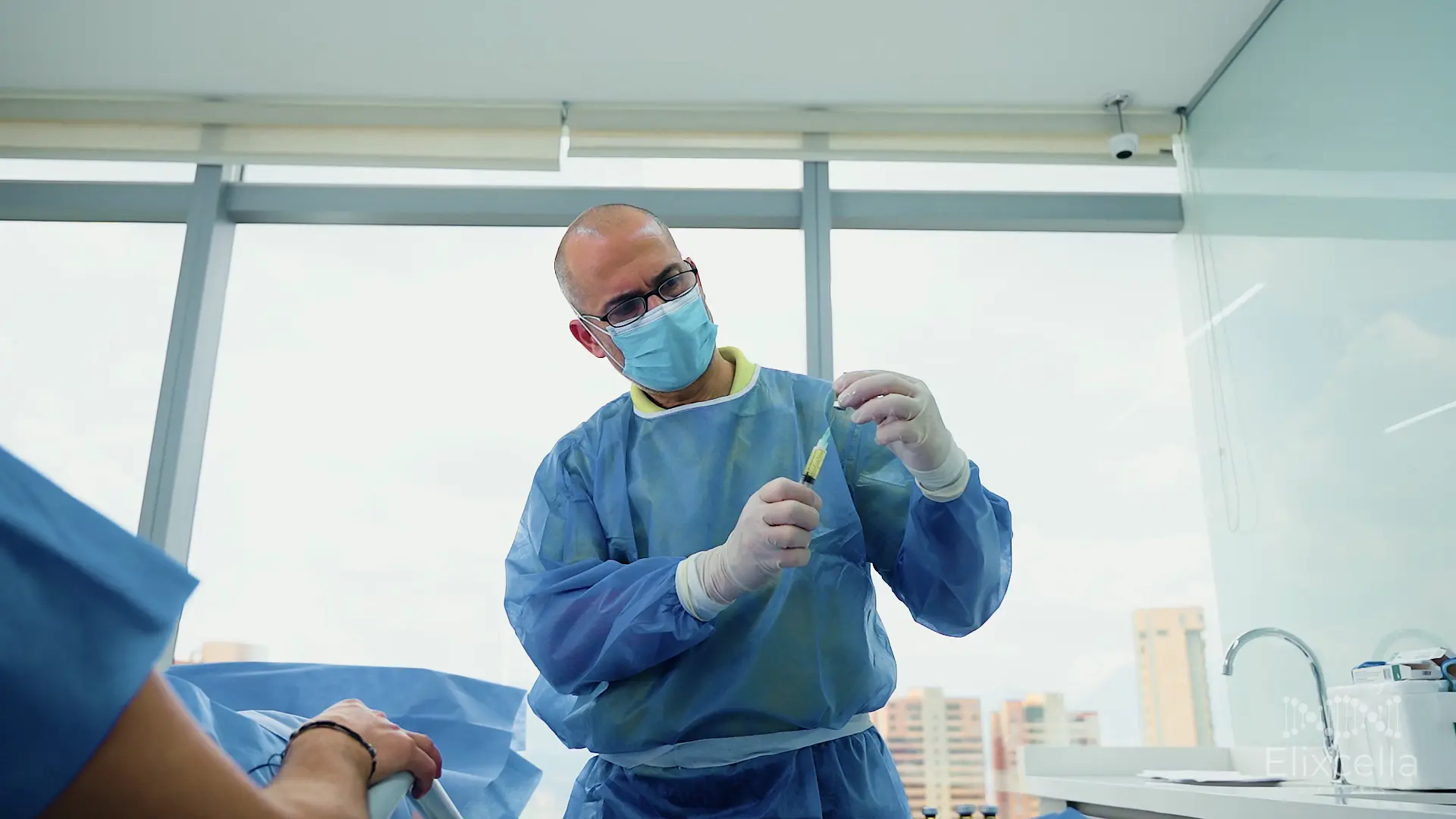
The mesenchymal stem cells (MSCs) we use are sourced from screened, donated umbilical cord tissue and expanded in our INVIMA-regulated laboratory. They're delivered to the knee via ultrasound-guided intra-articular injection — a 20 to 30 minute procedure under local anesthetic.
Once placed in the joint, MSCs work through three primary mechanisms:
- Paracrine signaling: MSCs secrete a cocktail of growth factors, cytokines, and extracellular vesicles that reduce inflammation, suppress pain pathways, and signal local chondrocytes to increase matrix production. This is the fastest-acting effect — most patients feel inflammation reduction within 2 to 4 weeks.
- Immunomodulation: MSCs interact directly with the synovium, dampening the chronic low-grade inflammation that's a hallmark of osteoarthritis. This is the mechanism most likely to produce lasting symptom improvement even in cases where structural change is limited.
- Direct chondrogenesis: A subset of injected MSCs differentiate into chondrocyte-like cells and contribute to cartilage matrix synthesis. This is the slowest mechanism, with measurable structural change appearing on MRI at 6 to 12 months in some patients.
The first two mechanisms account for most of the symptomatic improvement patients report. The third is what makes the result durable.
What the published outcomes actually show
The peer-reviewed literature on MSC therapy for knee OA has matured significantly in the last decade. The pattern across the major trials:
- Jo et al. (2014, Stem Cells): Phase I/II trial of intra-articular MSC injection. Patients with KL II-III showed significant improvement in WOMAC pain scores at 6 months, sustained at 24 months.
- Pers et al. (2016, Stem Cells Translational Medicine): Adipose-derived MSCs in severe knee OA showed dose-dependent improvement in pain, function, and quality of life.
- Vega et al. (2015, Transplantation): Randomized trial showed MSC injection outperformed hyaluronic acid for cartilage protection on MRI at 12 months.
- Kim et al. (2020, American Journal of Sports Medicine): Meta-analysis of 6 RCTs (203 patients) found significantly lower pain scores (VAS) after MSC injection vs. control, but no significant difference in MRI-assessed cartilage repair.
The honest read of this body of work: MSC injection is consistently effective for pain and function across KL I-III, with the strongest signals in mild-to-moderate disease. Evidence for structural cartilage regeneration is present but more variable. The patients with the most dramatic and durable results are typically those who combine the injection with structured rehab and weight management.
"I went into the clinic in June barely able to walk the dog around the block. By Christmas I was back on the elliptical. By the following spring I was hiking again. I'm 61 and my orthopedist still can't quite believe it."
— Margaret D., Portland, Oregon
Timeline: what to expect, month by month
Patients often ask "when will I feel better?" The honest answer is that the timeline varies, but the average curve looks like this:
Days 1 to 7: Mild post-injection soreness, sometimes a small effusion. We recommend ice and gentle movement. Avoid impact activity. Most patients are back to desk work the next day.
Weeks 2 to 4: The anti-inflammatory effect kicks in. Patients commonly report a reduction in morning stiffness and "weather pain." This is the paracrine signaling phase.
Months 1 to 3: The biggest functional gains. Most patients report meaningful improvement in walking distance, stair climbing, and overall pain by month 3. This is where the immunomodulation effect peaks.
Months 3 to 6: Continued improvement. Patients who were sedentary before treatment often start light strength training in this window. Some are released back to recreational activity (hiking, cycling, low-impact sports).
Months 6 to 12: Cartilage remodeling. Repeat MRI at month 12 in some patients shows measurable improvement in cartilage thickness or T2 mapping signal. Symptom benefit usually stable or continuing to improve.
Patients who don't respond to the first injection are typically identified by month 4. For non-responders, we discuss whether a second injection at 6 months is appropriate, or whether the case profile suggests surgery would be the better path.
Who we tell to skip stem cells and see a surgeon
Honesty matters more here than enthusiasm. We refer patients to orthopedic surgery rather than treat with stem cells when:
- KL Grade IV with bone-on-bone contact on weight-bearing X-ray. The cartilage runway has been consumed; biology can't outpace mechanics at this point.
- Severe varus or valgus deformity (bow-legged or knock-kneed beyond 10 degrees). The malalignment will continue damaging any regenerated cartilage.
- Mechanical symptoms (locking, catching, giving way) suggesting a loose body or significant meniscal tear that requires arthroscopic intervention first.
- Active joint infection or recent septic arthritis history.
- Inflammatory arthritis (rheumatoid, psoriatic) that's not under control with systemic management. Stem cells can still help here, but only after the systemic disease is suppressed.
- Significant ligamentous instability (untreated ACL or PCL deficiency) producing chronic abnormal joint mechanics.
The patients who do best with stem cells are those whose joints have structural runway left to work with — cartilage to protect, ligaments that are stable, alignment that's reasonable. If those conditions aren't met, we'll tell you.
Cost: Medellín vs. US
The economics, transparently:
| Treatment | Colombia Care, Medellín | US (where available) |
|---|---|---|
| MSC injection, single knee | $3,800 to $4,600 | $18,000 to $35,000 |
| MSC injection, both knees | $6,500 to $8,200 | $32,000 to $60,000 |
| Hyperbaric oxygen adjunct (10 sessions) | $1,200 included | $3,000 to $5,000 separately |
| Total knee replacement (alternative) | Not offered (we don't do surgery) | $35,000 to $70,000 |
For US patients, the main added trip costs are flights and a hotel near the clinic for 5 to 7 nights (not included; we can arrange it on request). Airport transfers are included.
Insurance coverage varies. Most US carriers do not cover stem cell injections regardless of where they're performed; HSA and FSA funds typically can be used for the procedure. We provide an itemized invoice in English with US-recognized procedure codes for any patient who wants to pursue out-of-network reimbursement.
What a trip to Medellín looks like
For a single-knee case, plan on 5 to 7 nights total. Day-by-day:
- Day 0: Arrive at Medellín José María Córdova airport. Bilingual driver pickup, transfer to your hotel in El Poblado.
- Day 1: Morning consultation with our regenerative medicine physician (2 to 3 hours). Review of imaging, clinical exam, treatment plan confirmation. Pre-procedure labs if not already done.
- Day 2: Injection day. The intra-articular MSC injection takes 20 to 30 minutes under ultrasound guidance and local anesthetic. You walk out. Afternoon free for rest.
- Days 3 to 5: Optional hyperbaric oxygen sessions (90 minutes each, in our adjacent facility). Bilingual physiotherapy consult to set up your home rehab plan. Light walking encouraged; impact activity avoided.
- Day 6 to 7: Final follow-up exam. Discharge instructions, MRI baseline imaging for the 6 and 12-month comparison, return-home protocol.
Most patients fly home on Day 6 or 7. Follow-up at month 3, 6, and 12 happens over video call, with optional repeat imaging from your local orthopedist forwarded to our team.
Imaging you'll need before booking
For us to give you an honest assessment before you fly down:
- Weight-bearing AP and lateral knee X-rays taken within the last 12 months (gives us KL grade).
- MRI of the affected knee if available (gives us cartilage thickness, meniscal status, ligament integrity). Within the last 24 months is ideal.
- Recent orthopedist or rheumatologist notes if you have them.
- A brief written history of symptom onset, progression, prior treatments tried (injections, PT, NSAIDs).
Send these to our team on WhatsApp or email. Our regenerative medicine physician reviews each case personally and replies within 48 hours with an honest assessment: whether you're a good candidate, what protocol we'd recommend, what realistic outcomes look like for your imaging profile, and a quote. Cases that aren't a good fit get told that — we'd rather lose a booking than treat a patient who shouldn't be treated.
The bigger picture
Knee replacement remains a remarkable operation when it's needed. For end-stage osteoarthritis with severe symptoms and structural collapse, no biologic intervention compares. But for the much larger group of patients sitting at KL I-III — patients whose orthopedist says "we'll probably need to operate in a few years, let's manage with injections in the meantime" — stem cell therapy is the most promising option that hasn't yet entered the US mainstream.
The science is mature. The technique is well-described. The infrastructure to deliver it under regulated, audited conditions exists. The barrier in the US is mostly regulatory and reimbursement-related, not scientific. The barrier in Colombia is much lower, which is why a procedure that costs $25,000 in Manhattan costs $4,000 here, performed in a clinic operating under INVIMA oversight and using donor tissue that meets the same screening standards as US tissue banks.
If the math, the timeline, and the imaging line up for your case, this is a serious option worth considering before you accept a surgical date.