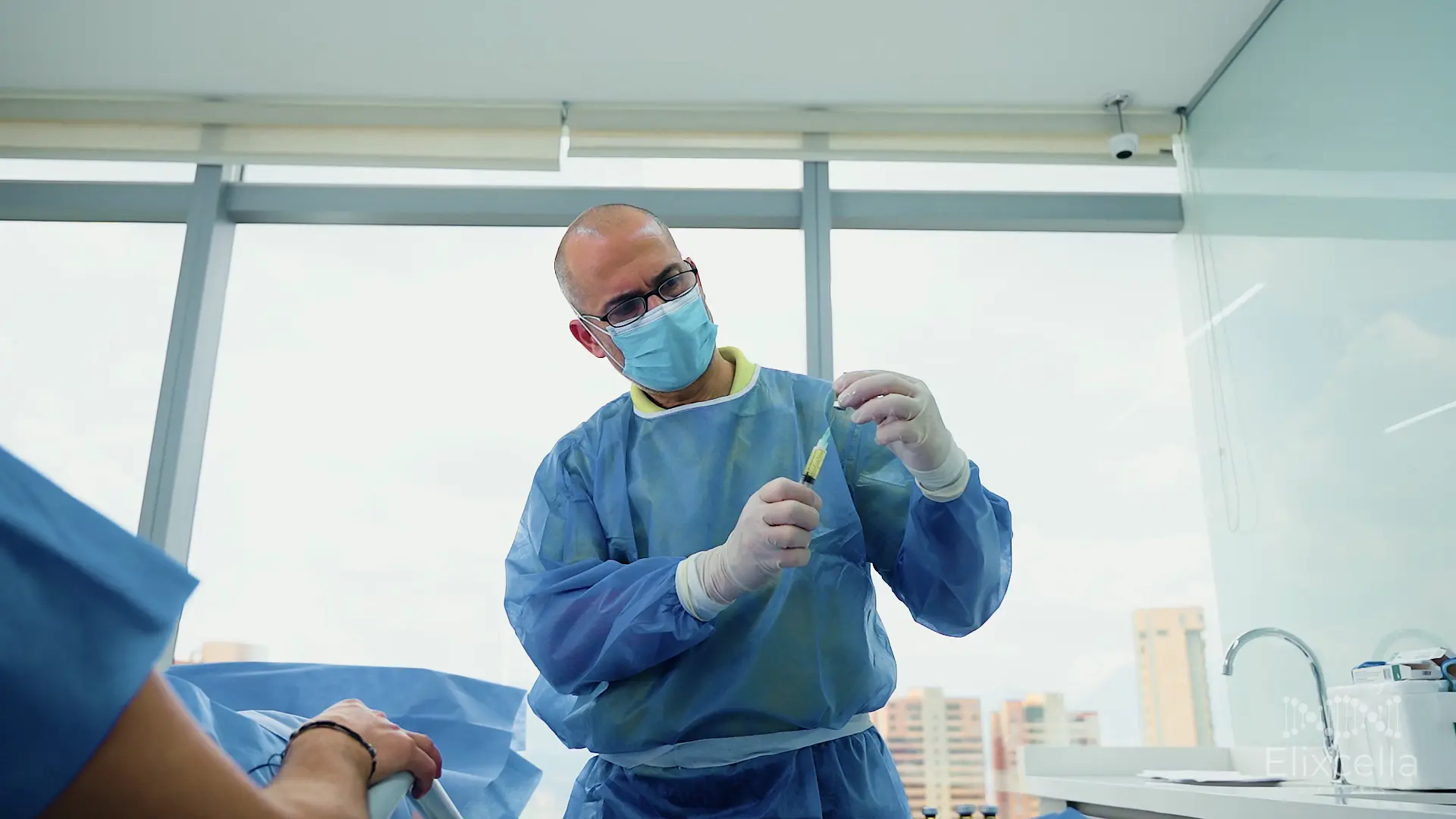
Most people researching cell therapy spend their time comparing conditions, prices and countries. Very few ask what happens in the eight to twenty days between the moment cells are collected and the moment they are put back into a body — which is unfortunate, because that interval is where almost all of the quality difference between clinics lives.
Two clinics can use identical language on their websites, treat the same condition, and deliver products that are not remotely comparable. The difference is not the injection. It is the laboratory.
A useful way to think about it: the cells are not the product. The characterized, counted, tested and documented cell preparation is the product. A vial of cells with no accompanying data is not a treatment — it is an unknown.
The quick answer
Cells collected from bone marrow, fat or donated umbilical cord tissue go through four laboratory stages: isolation (separating the cells of interest from everything else), expansion (culturing them until there are enough), characterization (proving they are what you claim) and release testing (confirming they are alive, sterile and identifiable before anything is infused).
There is an internationally recognized minimum definition for what counts as a mesenchymal stromal cell, published by the International Society for Cellular Therapy and still the reference standard nearly twenty years later.[1] A clinic that cannot tell you whether its product meets it, or cannot produce the flow cytometry to show it, is asking you to take the most important part on trust.
Stage one: isolation
Whatever the source tissue, what arrives at the laboratory is a mixture. Bone marrow aspirate is overwhelmingly blood and haematopoietic cells, with mesenchymal stromal cells present at roughly one in ten thousand to one in a hundred thousand nucleated cells. Adipose tissue yields a mixed population usually called the stromal vascular fraction. Umbilical cord tissue must first be enzymatically or mechanically dissociated.
Isolation separates the population of interest. In most protocols this exploits a simple property: mesenchymal stromal cells adhere to plastic, and most of what you do not want does not. The non-adherent fraction is washed away.
This is also the first point where clinics diverge meaningfully. A same-day procedure that takes bone marrow or fat, concentrates it in a centrifuge and re-injects it within an hour has performed isolation only in the loosest sense. That is a minimally manipulated autologous preparation, and it is a legitimate thing to do — but it is not the same as a culture-expanded, characterized cell product, and it should not be priced or described as though it were.
Stage two: expansion
Because the starting frequency is so low, clinically relevant doses require culture. Cells are grown in flasks or bioreactors, fed with medium, and passaged — lifted and re-plated at lower density — each time they approach confluence.
Two numbers matter here and are rarely volunteered.
Passage number. Each passage is a round of division. Cells do not divide indefinitely; with extended culture they enlarge, slow, drift in their surface marker profile and lose differentiation and secretory capacity. Most clinical protocols stay at or below passage five or six for this reason. "How many passages?" is a question a competent laboratory answers immediately.
Medium composition. Traditional protocols use fetal bovine serum. Many modern ones use human platelet lysate or defined xeno-free formulations, partly to reduce immunogenic and infectious risk and partly for regulatory reasons. Neither answer is disqualifying; not knowing the answer is.
Stage three: characterization
This is the stage that separates a documented product from a vial of something. The ISCT minimal criteria define a mesenchymal stromal cell by three properties: adherence to plastic under standard culture conditions; expression of CD105, CD73 and CD90 in at least 95 percent of cells, with expression of CD45, CD34, CD14 or CD11b, CD79a or CD19 and HLA-DR in no more than 2 percent; and the demonstrated ability to differentiate into bone, cartilage and fat lineages in vitro.[1]
Those criteria are a floor, not a ceiling, and the field knows it. In 2019 the ISCT revisited the terminology itself, recommending that the label "stem cell" be reserved for preparations where stemness has actually been demonstrated rather than assumed — and that most clinical preparations be described as mesenchymal stromal cells, with the tissue of origin stated.[2] The distinction is not pedantry. Clinics selling "stem cells" are almost always selling stromal cells, and the more honest ones say so.
The potency problem nobody has solved
Here is the part that responsible clinics should tell you and most do not: meeting the identity criteria does not prove a product will do anything.
Identity and potency are different questions. A preparation can tick every surface-marker box and still be therapeutically inert, and the field's difficulty in defining and measuring potency has been repeatedly identified as a central obstacle to translating cell therapy into reliable clinical practice.[3] Work continues on assay technologies[4] and on validated potency assay matrices designed to make manufacturing consistent between batches,[5] but there is no single universally accepted potency test for mesenchymal stromal cells today.
What follows from that is a limit on what anyone can honestly promise. A laboratory can tell you that a product is what it claims to be, that it is alive, and that it is sterile. It cannot currently certify that it will work. Any clinic implying otherwise is ahead of the science.
Stage four: cryopreservation, thawing and release
Most products are frozen at some point, for scheduling and for batch testing. Freezing is not neutral: cryoprotectant choice and protocol measurably affect viability, recovery and other quality parameters of the final product.[6]
The clinically relevant consequence is that viability should be measured after thawing, immediately before administration — not on the fresh culture weeks earlier. A clinic quoting a pre-freeze number is quoting the wrong number.
Release testing before anything reaches a patient should cover, at minimum: post-thaw viability, cell count and dose, sterility, mycoplasma, endotoxin and identity by flow cytometry.
What a documented process looks like
| Question | A documented lab | Warning sign |
|---|---|---|
| Cell source | Named tissue, autologous or donor, with donor screening if allogeneic | "Stem cells" with no source stated |
| Identity | Flow cytometry report against ISCT markers | No data, or "our lab is proprietary" |
| Passage number | Stated, typically P3 to P5 | Unknown or unanswered |
| Viability | Measured post-thaw, immediately pre-infusion | A fresh-culture figure, or none |
| Sterility, mycoplasma, endotoxin | Per batch, results available | "The lab handles that" |
| Dose | Cells per kilogram or per joint, with rationale | Vials, syringes or "millions" with no denominator |
| Regulatory status | Named authority and registration | Vague appeals to being "certified" |
You are entitled to ask for every row of that table in writing before you travel, and the answers should arrive without friction. In Colombia the relevant authority is INVIMA, and what its oversight does and does not cover is worth understanding before you evaluate any clinic's claims — we cover that in INVIMA regulation and what it means for stem cell therapy. The broader due-diligence list is in 12 questions to ask a stem cell clinic before you book.
Who this is and is not for
Understanding laboratory standards helps you judge a clinic. It does not make you a candidate. Cell therapy may be reasonable to discuss if you have a diagnosed orthopaedic or degenerative condition, have tried appropriate conservative treatment, have realistic expectations of partial and gradual improvement, and can be evaluated on current imaging.
It may not be right for you if: you have an active malignancy or a recent cancer history; you have an active infection; you are pregnant or breastfeeding; your joint has structurally collapsed, in which case an orthopaedic surgeon is the correct referral; you are taking immunosuppressive or anticoagulant therapy that has not been reviewed; or you are being offered treatment for a condition on which the evidence does not support it. We decline cases in each of those categories, and a clinic that has never turned you down for anything has not assessed you.
No one can guarantee an outcome from cell therapy. The honest framing is a possibility of meaningful improvement in a subset of appropriately selected patients, with an established short-term safety profile and genuinely incomplete long-term data. For the wider picture of what the research supports, see what mesenchymal stem cell research actually shows in 2026.
The bottom line
The laboratory is the least visible and most decisive part of cell therapy. Isolation, controlled expansion at a documented passage number, characterization against a recognized standard, and post-thaw release testing are what turn a biological sample into something defensible. None of that is exotic, and none of it is secret — which is exactly why a clinic's inability or unwillingness to describe its own process tells you what you need to know.
Ask for the flow cytometry report. If it arrives, you are dealing with a laboratory. If the subject changes, you are dealing with marketing.