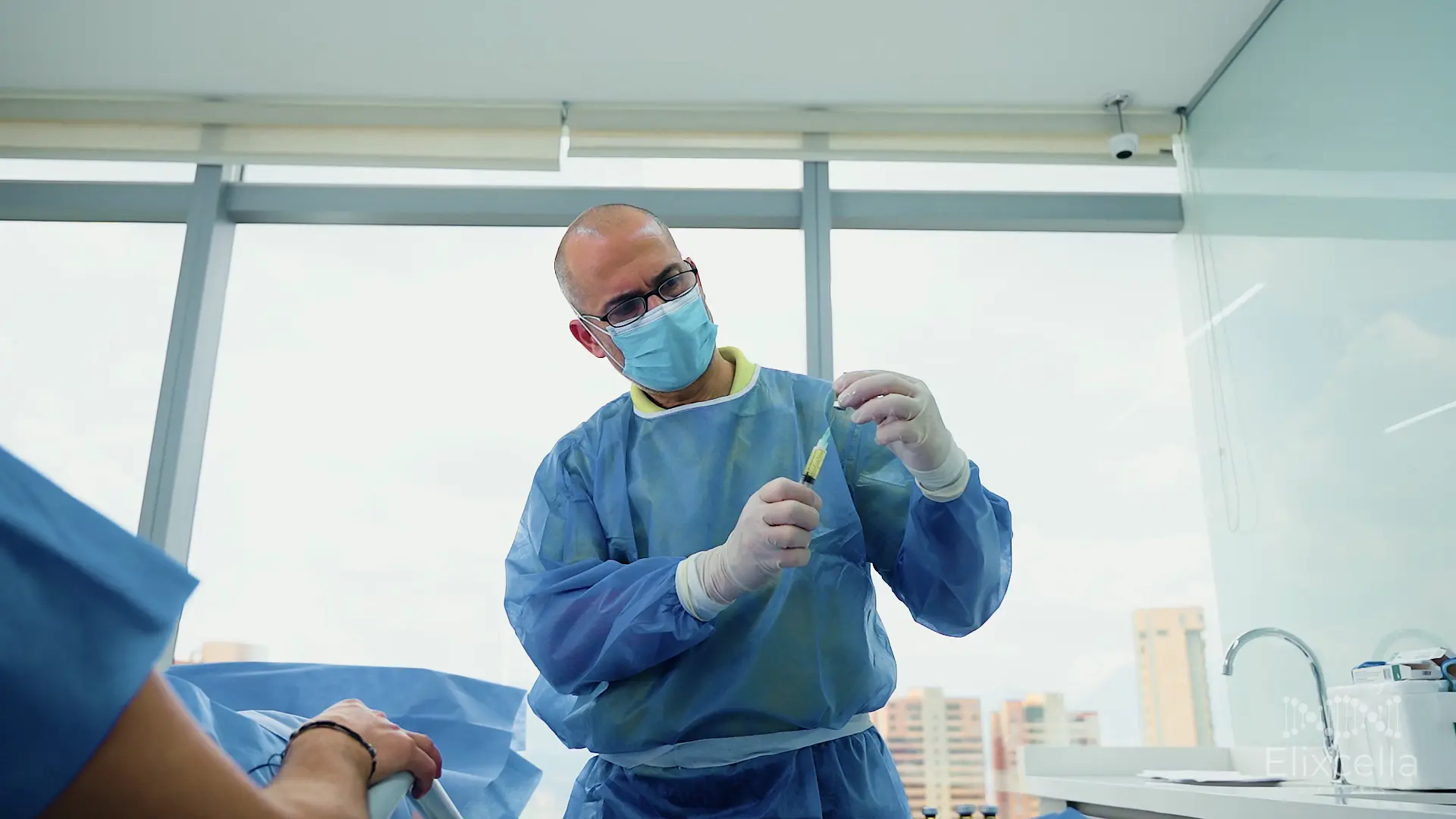
Regenerative medicine is a field where the quality gap between clinics is enormous and almost invisible from the outside. Two websites can look equally polished, quote a similar price, and use identical vocabulary — while one runs a regulated lab with characterized cells and the other injects an unquantified product with no release testing at all.
You cannot tell the difference from the marketing. You can tell it from the answers to a dozen specific questions. This is that list, in the order we'd ask them. We've also answered each one for our own clinic, because a checklist you can't turn on the people who wrote it isn't worth much.
The single most useful question isn't on any brochure: "What conditions do you turn away, and what percentage of enquiries do you decline?" A clinic that treats everyone is telling you it evaluates no one.
The quick answer
If you only have five minutes, ask these four: What exactly are you injecting, and how many cells? Who regulates you, and can I see the registration? What does the published evidence say for my specific condition? Under what circumstances would you tell me I'm not a candidate? A clinic that answers all four in specifics rather than adjectives is already in a small minority. The other eight questions below sharpen the picture.
1. What type of cells are you actually using?
"Stem cells" is not a product description. The answer should name a specific cell population — most commonly mesenchymal stromal cells (MSCs) — and the tissue they came from: umbilical cord (Wharton's jelly), bone marrow, or adipose tissue. Each has different characteristics, and cord-derived MSCs from a young donor behave differently from your own bone marrow at 65.
Be alert to vagueness. "Regenerative cells," "stem cell product," and "biologic" are marketing terms that can cover anything, including preparations containing few or no living stem cells. If the clinic can't name the cell type and source in one sentence, that's your answer.
Our answer: Umbilical cord–derived mesenchymal stromal cells from screened, consented donors, expanded in a controlled laboratory.
2. How many cells will I receive, and how do you know?
Dose matters, and it is the number clinics are most likely to avoid putting in writing. You want a specific cell count per treatment, and — critically — you want to know it was measured, not estimated from a protocol. Ask whether each batch gets a cell count and viability percentage before release, and ask what viability threshold they refuse to release below.
This question separates labs from kitchens. A clinic running proper release testing will answer immediately with numbers and a threshold. A clinic that improvises will talk about "millions of cells" without specifying how many or how they know.
3. Are the cells characterized to a recognized standard?
There is an international definition of what qualifies as an MSC. The International Society for Cellular Therapy published minimal criteria in 2006 — plastic adherence, a specific surface-marker profile (CD73, CD90, CD105 positive; CD45, CD34, CD14 negative), and demonstrated tri-lineage differentiation capacity. It remains the reference standard.
You don't need to memorize the markers. You need to ask, "Do your cells meet the ISCT minimal criteria, and do you test for the surface markers?" A credible lab knows exactly what you're referring to. A clinic that has never heard of it is not characterizing what it sells.
4. Who regulates you — and can you show me?
Ask for the name of the regulator and the registration itself, not a reassurance that the clinic is "fully licensed" or "internationally accredited" (a phrase with no fixed meaning). In Colombia the relevant authority is INVIMA, the national medicines and health-products regulator, and facilities and cell-processing labs operate under its oversight. We've written a full explainer on what INVIMA is and why it matters.
The general principle travels: whatever country you're considering, there should be a named regulator, a verifiable registration, and a willingness to show you both.
5. How are donors screened, and how is the tissue tested?
For donor-derived (allogeneic) cells, ask about donor screening and infectious-disease testing — the same categories tissue banks screen for, including HIV, hepatitis B and C, and syphilis. Ask whether the final product is tested for sterility and endotoxin before release. These are basic safety steps, and a clinic that treats the question as unusual is telling you something important.
6. What does the published evidence say for my condition — specifically?
The evidence base for MSC therapy is genuinely uneven. It is strongest for joint conditions like knee osteoarthritis, more preliminary for spine and several inflammatory conditions, and thin-to-absent for the broad "anti-aging" claims that some clinics lead with. A credible clinic will tell you which bucket your condition sits in and will hand you actual papers.
Ask for citations you can look up yourself. Then look them up. We keep an honest summary of the state of the research in our guide to what MSC research actually shows in 2026, and condition-specific reviews for knee osteoarthritis and tendinopathy.
| What you ask | Credible answer sounds like | Walk away if |
|---|---|---|
| Cell type and source | Named population and tissue, in one sentence | "Regenerative cells," "our proprietary blend" |
| Dose and viability | A specific count and a release threshold | "Millions of cells," no measurement |
| Regulation | Names the regulator, shows registration | "Internationally accredited," no specifics |
| Evidence for your condition | Real citations, honest about limits | Only testimonials and before/after photos |
| Expected outcome | A range, a timeline, a non-response rate | A guarantee, or "it works for everyone" |
| Who isn't a candidate | Specific exclusion criteria | "We can help with almost anything" |
7. What outcome should I realistically expect — including the chance of none?
The honest answer to "will this work?" is a range and a probability, never a promise. Ask three things: what magnitude of improvement is typical, how long it takes to appear, and what proportion of patients don't respond at all. That last number is the one hype clinics never volunteer, and every real treatment has one.
Anyone guaranteeing a result, promising a cure, or describing an outcome as definitive is making a claim that the evidence in this field does not support — regardless of how confident they sound.
8. Who would you turn away?
Ask for the exclusion criteria in plain terms. A clinic with real medical governance can list them: active malignancy, active infection, pregnancy, certain blood disorders, and — importantly — structural situations where cells simply aren't the right tool. Bone-on-bone end-stage arthritis with complete joint-space loss is a common example where a joint replacement, not an injection, is the appropriate treatment.
Our answer: we decline cases regularly, and we'd rather tell you before you buy a plane ticket than after. If your imaging and history point somewhere else, that's what our medical team will say.
9. Who performs the procedure, and what are their credentials?
Ask for the name and specialty of the physician who will actually treat you — not the clinic's founder or the doctor featured on the homepage. For joint injections, ask whether they're image-guided (ultrasound or fluoroscopy). Accurate placement into the target tissue is not a luxury; a well-prepared cell product delivered to the wrong compartment is a wasted treatment.
10. What is the total cost, and what happens if I need a second treatment?
Ask for an itemized price: cells, procedure, imaging, follow-up, and any adjunct therapies. Then ask the uncomfortable follow-up — if the response is partial, what does a second round cost, and is it discounted? Clinics that quote a headline price and reveal the rest later tend to reveal other things later too. Our cost breakdown explains why the Colombia figure is structurally lower without the standards being lower.
11. What follow-up do you provide after I fly home?
Regenerative treatment doesn't end when you leave the building — the response typically develops over weeks to months. Ask who you contact when you have a question at week six, what the follow-up schedule looks like, and whether anyone will be tracking your outcome at all. "Tracking outcomes" is a good proxy for whether a clinic is practising medicine or selling a product.
12. Why is this not available at home?
A clinic should be able to explain the regulatory picture honestly. In the US, expanded-cell products are regulated as drugs and require FDA approval pathways that most clinics haven't completed — which is a statement about regulation and commercial pathways, not proof that the biology is fake. Be equally wary of the opposite spin: any clinic implying it has discovered something the rest of medicine has missed is selling you a story.
It's worth knowing that the direct-to-consumer stem cell industry has been studied and criticized precisely because so many clinics market unproven applications with confident language. That research is a reason to ask harder questions, not a reason to dismiss the field.
A note on what this treatment is not
Regenerative therapy may not be right for you. It is not a cure, it is not guaranteed, and it is not a substitute for surgery when a joint is structurally beyond repair. Results vary between patients, some people experience no meaningful benefit, and honest clinics say so before taking your money rather than after. If you have an active cancer, an active infection, are pregnant, or your imaging shows end-stage structural damage, this is very likely not the right treatment for you.
If a clinic — including ours — ever gives you an answer to the twelve questions above that is smoother than it is specific, treat that as the finding. The clinics worth your money are the ones willing to be boring, precise, and occasionally discouraging.
If you'd like those answers for your own case, our medical team will give them to you honestly, including telling you when the answer is no.