Chronic tendon pain is one of the most frustrating problems in orthopedics — for patients and physicians alike. Tennis elbow that lingers for a year. An Achilles that aches every morning. A patellar tendon that flares every time you try to run again. Unlike a torn ligament, tendinopathy usually isn't a single dramatic injury; it's a slow failure of the tendon to repair itself, and the standard treatments — rest, physical therapy, anti-inflammatories, cortisone — often manage symptoms without fixing the underlying tissue. That gap is where regenerative approaches, including stem cell (mesenchymal stromal cell) therapy, have drawn serious research interest.
This article is an honest look at what stem cell therapy for tendinopathy can and cannot do, based on the published clinical literature as of 2026. We'll cover what tendinopathy actually is, what the evidence supports, who tends to be a reasonable candidate, who should look elsewhere, and what a realistic protocol and cost in Medellín look like. We are a regenerative medicine clinic, so we have a point of view — but the goal here is calibrated expectations, not hype.
Quick answer
- What it is: Ultrasound-guided injection of mesenchymal stromal cells (MSCs) into or around a chronically degenerated tendon, aimed at reducing pain and supporting the tendon's own repair.
- What the evidence shows: Early clinical studies and systematic reviews report encouraging improvements in pain and function for several tendinopathies, but the trials are mostly small and heterogeneous. The signal is promising, not definitive.
- Best-fit cases: Chronic tendinopathy (typically 3–6+ months) that has failed a genuine course of loading-based physiotherapy, with imaging-confirmed tendon degeneration but no complete tear.
- Poor-fit cases: Full-thickness tendon ruptures, acute injuries that haven't been given rehab a fair chance, and active infection.
- Cost in Medellín: roughly $2,800 to $4,500 depending on the tendon, cell dose, and whether adjuncts are added.
Stem cell therapy for tendinopathy is a reasonable option to consider when conservative care has genuinely failed — not a guaranteed cure, and not a shortcut around rehabilitation. Any clinic that promises certainty is overselling the science.
What tendinopathy actually is
For years the problem was called "tendinitis," implying inflammation. Research over the last two decades has largely reframed it as tendinopathy: a failed healing response in which the tendon's collagen becomes disorganized, cells behave abnormally, and small blood vessels and nerves grow into tissue that shouldn't have them. Classic inflammation is often minimal, which is exactly why anti-inflammatory strategies (including repeated cortisone) frequently disappoint and, in some tendons, may even weaken the tissue over time.
The tendons most commonly affected — and most studied for cell therapy — include:
- Lateral epicondyle (tennis elbow): pain on the outer elbow, worse with gripping.
- Achilles: mid-portion or insertional pain and stiffness, common in runners and midlife weekend athletes.
- Patellar (jumper's knee): pain just below the kneecap, aggravated by jumping and squatting.
- Rotator cuff tendons: shoulder pain and weakness; a distinct topic we cover in depth in our shoulder and rotator cuff guide.
- Gluteal / hip and hamstring tendons: less common but increasingly recognized.
The unifying feature is chronicity. Most tendinopathies that reach a regenerative-medicine consultation have been present for many months and have already been through physiotherapy, activity modification, and often one or more cortisone injections.
The rationale: why cells, not just steroids
Mesenchymal stromal cells are best understood not as a "replacement part" but as biological signalers. In tendon tissue, the proposed mechanisms are:
- Paracrine signaling: MSCs secrete growth factors and extracellular vesicles that can dampen the abnormal cell environment and encourage resident tendon cells (tenocytes) to lay down more organized collagen.
- Immunomodulation: they help regulate the low-grade, dysfunctional tissue environment that characterizes chronic tendinopathy.
- Support of matrix remodeling: the aim is a gradual shift toward healthier tendon structure, which is why benefits — when they occur — build over months rather than days.
Importantly, there is also biological evidence that the availability of native progenitor cells matters: Hernigou and colleagues found reduced mesenchymal stem cell counts at the tendon-bone interface in patients with symptomatic rotator cuff tears, one line of reasoning behind supplementing that biology.
What the published evidence actually shows
Here is the honest state of the literature. The results are encouraging but should be read with the small-trial caveat firmly in mind.
| Area | What the studies suggest | Strength of evidence |
|---|---|---|
| Tendon disorders (overall) | Systematic reviews of clinical studies report improvements in pain and function with cell therapy, with a generally favorable short-term safety profile | Low–moderate; mostly small studies |
| Lateral epicondylitis | Early trials using tendon-derived / skin-derived tenocyte-like cells showed reduced pain and improved imaging appearance vs. baseline | Low; small, early-phase |
| Rotator cuff (surgical augmentation) | Adding bone-marrow MSCs at the time of cuff repair was associated with improved healing and fewer re-tears in a case-controlled study | Moderate for augmentation; not the same as injection alone |
| Tendon & ligament injuries (review) | Clinical-evidence reviews conclude MSCs are promising and appear safe, while calling for larger randomized trials | Low–moderate |
The consistent thread across these papers is twofold: (1) the safety profile in the short-to-medium term has been reassuring, and (2) the efficacy signal is real but not yet backed by the kind of large, randomized, long-term trials that would let anyone promise a specific result. A responsible clinic states both halves of that sentence.
It's also worth separating cell therapy from platelet-rich plasma (PRP), which is frequently discussed alongside it. PRP is a different, more established (and cheaper) biologic, and meta-analyses of ultrasound-guided PRP for tendinopathies show mixed-to-modest benefits. We sometimes use PRP as an adjunct or a first step, and we'll say so plainly rather than pushing the most expensive option by default.
Who tends to be a reasonable candidate
Cell therapy for tendinopathy makes the most sense for a fairly specific profile:
- Chronic, not acute: symptoms lasting roughly 3–6 months or more.
- Failed genuine conservative care: you've done a real, progressive loading (eccentric/heavy-slow resistance) physiotherapy program — not just rest — and still have limiting pain.
- Imaging-confirmed tendinopathy: ultrasound or MRI shows tendon degeneration or partial change, without a complete rupture.
- Realistic goals: you want meaningful pain reduction and a better shot at returning to activity, and you understand improvement builds over months.
- Reasonable general health: no active infection, uncontrolled diabetes, or active cancer requiring treatment.
When it may not be right for you
This is the part that matters most, and the part hype tends to skip. Stem cell therapy is probably not the right choice if:
- You have a complete (full-thickness) tendon tear or rupture. That is usually a surgical question, not an injection one.
- You haven't truly done rehab. A structured loading program resolves a large share of tendinopathies on its own. Skipping it to jump to injections is putting the expensive step first.
- Your pain isn't actually tendon-related. Nerve entrapment, referred pain, and joint pathology can masquerade as tendinopathy; imaging and a proper exam matter.
- You expect a one-and-done guarantee. The evidence doesn't support certainty, and neither will we.
- There's active infection at the site or systemically.
If any of these describe you, we would rather tell you honestly than book a procedure that isn't in your interest. Turning down a poor-fit case is part of doing this responsibly. Our page on how regenerative medicine is regulated in Colombia explains the oversight framework we operate under and why that candor is built into the process.
What a protocol looks like
For a typical tendinopathy case at our clinic in Medellín:
- Assessment: review of your history, prior rehab, and imaging. If imaging is old or incomplete, we arrange updated ultrasound or MRI.
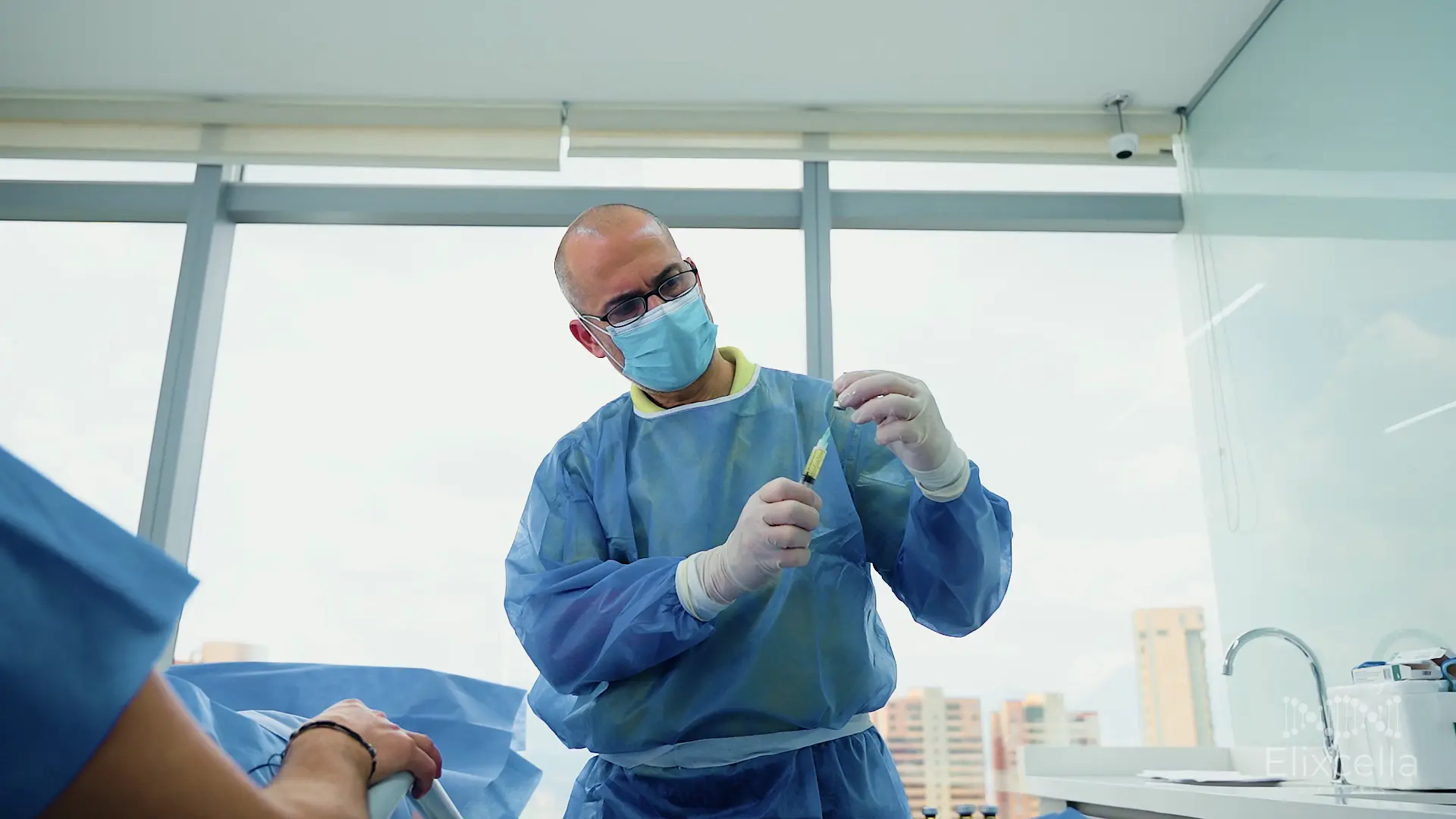
- The procedure: an ultrasound-guided injection of mesenchymal stromal cells (sourced from screened, donated umbilical cord tissue and expanded in an INVIMA-regulated laboratory) into and around the affected tendon, under local anesthetic. It's an outpatient procedure of roughly 20–40 minutes.
- Adjuncts (case by case): some patients add PRP or hyperbaric oxygen sessions; these are discussed, not assumed.
- Rehabilitation: a progressive loading program afterward is not optional — the cells and the rehab work together. We set up a plan you continue at home.
Timeline: what to expect
Weeks 1–2: relative rest and protected loading; some post-injection soreness is normal.
Weeks 2–6: gradual return to a structured loading program; early pain changes vary widely between patients.
Months 2–6: this is where meaningful improvement, when it happens, tends to show — because tendon remodeling is slow. Response is assessed at these checkpoints, not at week one.
Cost in Medellín vs. the US
| Item | Colombia Care, Medellín | US (where offered) |
|---|---|---|
| MSC injection, single tendon | $2,800 to $4,500 | $5,000 to $12,000+ |
| PRP (as adjunct or first step) | Often bundled or low added cost | $500 to $2,000 per session |
| Updated diagnostic ultrasound | Included in workup | Variable |
For international patients, add roughly $1,000 to $2,000 for flights and a short stay. Most single-tendon cases need only a few days on the ground. Our full breakdown of why regenerative care costs less in Medellín explains where the savings come from — it's the cost structure, not a compromise on lab standards or oversight.
The honest bottom line
Chronic tendinopathy is a genuinely hard problem, and the fact that so many people arrive having "tried everything" is exactly why interventions like cell therapy attract attention. The research to date is encouraging: multiple clinical studies and reviews report improved pain and function with a reassuring short-term safety profile. But the studies are mostly small, the protocols vary, and no honest reading of the data supports a promise of guaranteed cure. What it supports is this: for the right patient — chronic, imaging-confirmed, rehab-refractory, and realistic — stem cell therapy is a reasonable option worth discussing, ideally alongside (not instead of) a serious loading program.
If you're weighing it for orthopedic tendon or joint pain more broadly, our overview of regenerative approaches in orthopedics puts tendinopathy in context with the other conditions where the evidence is further along.