Shoulder pain is one of the most common reasons people start looking into regenerative medicine. The shoulder is a shallow, mobile joint held together mostly by soft tissue — the rotator cuff — so it's prone to tendon wear, partial tears, and a slow grind of inflammation that physical therapy and cortisone don't always fix. The next step your orthopedist offers is often surgery. For the right patient, stem cell therapy sits in the gap before that.
This is an honest guide to where MSC therapy fits for the shoulder: which problems respond, which genuinely need surgery, what the imaging has to show, what the published outcomes look like, and what it costs in Medellín.
Quick answer
- Rotator cuff tendinopathy / partial-thickness tears: Strong fit. This is where MSC therapy has the most consistent results — reducing inflammation, supporting tendon healing, and improving function.
- Small full-thickness tears with good tissue quality: Possible candidate, sometimes alongside or instead of repair. Depends heavily on the MRI.
- Large/massive full-thickness tears, retracted tendons, fatty infiltration: Usually NOT a stem-cell case. The tendon ends need to be surgically reattached; cells can't bridge a real gap. We refer these to a shoulder surgeon.
- Mild–moderate shoulder osteoarthritis (glenohumeral): Good fit, similar logic to knee OA.
- Cost in Medellín: $3,500–$4,400 for the injection protocol, plus optional hyperbaric and IV adjuncts.
Why the shoulder is different from the knee
The knee is a weight-bearing hinge with cartilage as the main wear surface. The shoulder is a soft-tissue joint: a ball sitting against a shallow socket, stabilized by four rotator cuff tendons. Most shoulder pain isn't cartilage — it's tendon. That changes what regenerative therapy is trying to do. Instead of protecting a cartilage surface, we're trying to calm and support healing tendon tissue.
It also changes the honesty test. A tendon that's torn but still has good length and quality can heal with biologic support. A tendon that's fully ruptured and retracted (pulled back like a snapped rubber band) cannot — no injection re-attaches it. The MRI is what separates these two situations, which is why we insist on seeing it.
What the imaging needs to show
Before we can give you an honest assessment, we need an MRI of the shoulder (within ~24 months) and ideally a recent orthopedic note. The MRI tells us:
| MRI finding | Stem cell fit |
|---|---|
| Tendinopathy / tendinosis (no tear) | Excellent |
| Partial-thickness tear | Excellent |
| Small full-thickness tear, good tissue, no retraction | Good — case by case |
| Large/massive tear, retraction, fatty infiltration (Goutallier 3–4) | Surgery preferred |
How mesenchymal stem cells target the rotator cuff
The mesenchymal stem cells (MSCs) we use are sourced from screened, donated umbilical cord tissue and expanded in our INVIMA-regulated laboratory, then delivered under ultrasound guidance to the affected tendon and joint. Their dominant action in tendon isn't becoming new tissue — it's signaling:
- Anti-inflammatory and paracrine signaling: MSCs secrete growth factors and vesicles that calm the chronic inflammation driving most shoulder pain, often producing symptom relief within weeks.
- Tendon support: They signal local tendon cells (tenocytes) to increase repair activity and improve the quality of healing tissue — the mechanism most relevant to partial tears and tendinopathy.
- Immunomodulation: They dampen the low-grade inflammatory environment that keeps a shoulder from settling down.
What the published outcomes show
The evidence for biologic therapy in the rotator cuff has grown, especially as an augment to healing and for partial tears:
- Hernigou et al. (2014, International Orthopaedics): Bone-marrow MSC augmentation during rotator cuff repair improved healing rates and reduced re-tears versus repair alone, with the benefit sustained at long-term follow-up. PubMed
- Jo et al. (2018, Stem Cells): First-in-human trial of adipose-derived MSC injection for rotator cuff disease showed reduced tear size and improved function with a favorable safety profile. PubMed
- Reviews of MSC therapy for tendinopathy: Consistently report pain and function improvement for partial/degenerative tendon disease, with weaker evidence for large structural tears. PubMed
The honest read: the signal is strongest for tendinopathy and partial tears, and for improving the healing environment. It is weakest for large, retracted, full-thickness tears — exactly the cases we refer out.
"Two cortisone shots and a year of PT and my shoulder still woke me up at night. The injection plus the rehab plan finally let me sleep on that side again. I'm back to swimming."
— David R., Austin, Texas
Timeline: what to expect
Weeks 1–3: Mild post-injection soreness, then the inflammation begins to settle. Gentle range-of-motion only; no heavy lifting or overhead loading.
Weeks 4–8: Most patients notice meaningful pain reduction and easier daily movement. Structured rehab begins in earnest — the rehab is not optional; it's half the result.
Months 3–6: Strength and function continue to improve. Tendon-quality changes, when they occur, show on follow-up imaging in this window.
Cost in Medellín (2026)
| Item | Colombia Care (Medellín) | US (where available) |
|---|---|---|
| MSC injection protocol, one shoulder | $3,500 – $4,400 | $8,000 – $25,000 |
| Hyperbaric oxygen adjunct (optional) | $1,200 included in package | $3,000 – $5,000 separately |
| Rotator cuff surgery (the alternative) | Not offered (we don't do surgery) | $15,000 – $35,000 |
Add roughly $1,200–$2,000 for flights and 5–6 nights in Medellín. Insurance generally doesn't cover stem cell injections regardless of location; HSA/FSA funds usually can be used, and we provide an itemized invoice with US-recognized codes. The fuller cost logic is in our Colombia vs US cost comparison.
What a trip looks like
- Day 0: Arrive in Medellín; bilingual driver pickup to your El Poblado hotel.
- Day 1: Physician consult — review of your MRI, exam, and plan confirmation.
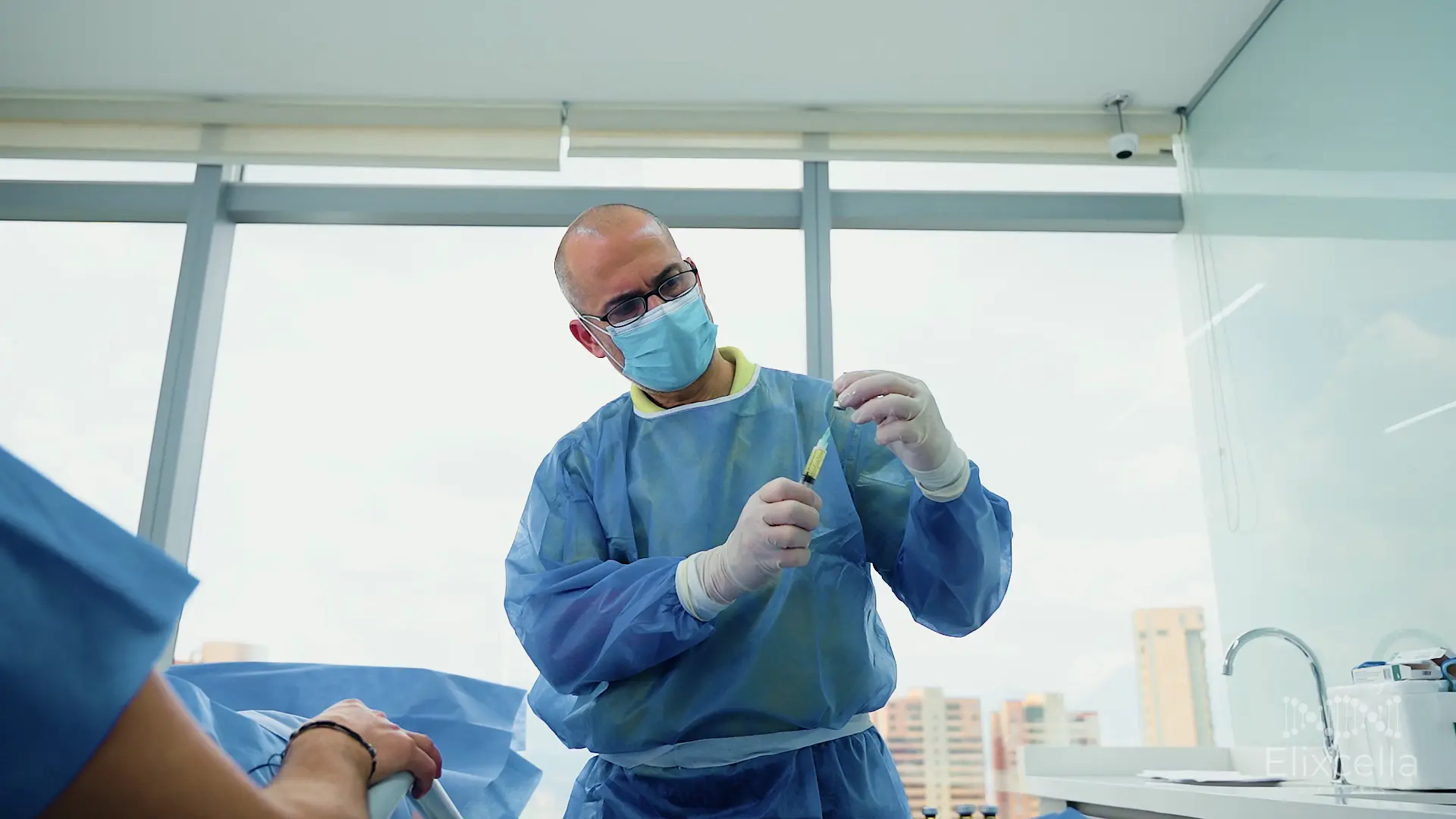
- Day 2: Ultrasound-guided injection (20–30 min, local anesthetic). Afternoon rest.
- Days 3–5: Optional hyperbaric oxygen sessions; physiotherapy consult to set your home rehab plan.
- Day 5–6: Final exam, discharge instructions, video follow-up scheduled for months 3 and 6.
When we'll tell you to have surgery instead
We'd rather lose a booking than treat a shoulder that needs a surgeon. We refer out when the MRI shows a large or massive full-thickness tear, significant tendon retraction, or advanced fatty infiltration — situations where the tendon must be mechanically reattached. Honest candidate selection is the whole game in shoulder regenerative medicine; a clinic that says "we can treat any shoulder" is one to avoid. The same evidence-and-honesty framework applies across conditions — see our overview of what MSC research actually shows and our look at regenerative orthopedics.
The bottom line
For rotator cuff tendinopathy, partial tears, and mild-to-moderate shoulder arthritis, stem cell therapy is a credible, evidence-supported option to try before surgery — especially when PT and injections have stalled. For large, retracted tears, it isn't a substitute for repair, and we'll tell you so. If your imaging and history line up, it's worth an honest assessment before you accept a surgical date.